Artificial Intelligence in Nursing: What It Means for Your Practice

AI is already in nursing practice, embedded in documentation assistants, predictive monitoring systems, and imaging analysis tools. It won’t replace nurses. It handles data work so nurses can focus on direct patient care. Understanding how these tools work, and where they fall short, is increasingly part of the job.
Sponsored School(s)


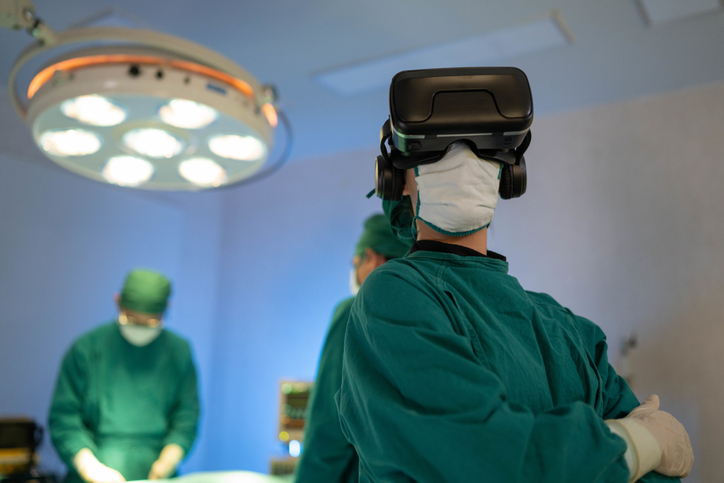 AI has already moved into clinical settings. It’s embedded in EHR documentation tools, patient monitoring systems, and clinical decision support software at health systems across the country. The question of whether it will affect nursing practice is settled. The useful questions are what it actually does, where it works, and where it fails.
How AI Is Already Being Used in Nursing
 AI works its way into nursing practice across three broad areas: documentation, patient monitoring, and clinical decision support. In each case, the underlying function is the same. The system processes large amounts of data faster than a human can and surfaces a result for the clinician to act on.
AI Documentation Assistants
 Ambient documentation tools listen to patient-provider conversations and automatically generate clinical notes. Nuance DAX, integrated with major EHR platforms and deployed at health systems across the country, is one of the most widely used. EHR platforms, including Epic, have added AI features that draft after-visit summaries, flag incomplete documentation, and suggest billing codes. The goal is to reduce the hours nurses spend charting so more time is available for direct patient care. Adoption varies by institution, but these tools are moving from pilot programs into standard deployment.
Predictive Patient Monitoring
 AI-powered early warning systems analyze patterns in patient data to identify deterioration before it becomes a crisis. The CONCERN (COmmunicating Narrative Concerns Entered by RNs) system uses machine learning on real-time nursing documentation to flag deterioration risk and has shown measurable improvements in patient outcomes at facilities where it has been deployed. Early warning systems like this give the nurse a faster signal to act on. They don’t replace bedside assessment. They give bedside assessment a head start.
The same logic extends to remote and wearable monitoring. Connecting AI systems with patient-worn sensors allows nursing staff to maintain clinical oversight of patients outside the immediate ward, a model already in use in some home care and telemetry settings.
Clinical Decision Support
 Clinical decision support tools flag potential medication interactions, dosage errors, and protocol deviations in real time. AI-powered search in EHR systems lets nurses retrieve information using plain-language questions instead of navigating rigid menu structures. In radiology, computer vision systems analyze imaging data alongside clinicians and have demonstrated accuracy comparable to specialist review on some diagnostic tasks in research and selected clinical applications. These tools don’t make clinical decisions. They surface information faster, so nurses can.
Will AI Replace Nurses?
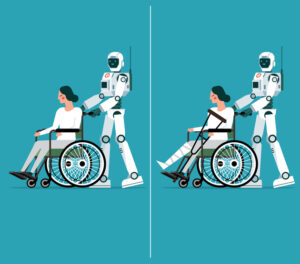 AI is unlikely to replace the core functions of nursing, which depend heavily on human judgment, communication, advocacy, and physical care. Nursing requires physical presence, clinical judgment under ambiguous conditions, patient advocacy, and communication across cultural, emotional, and clinical contexts that AI doesn’t navigate reliably.
What AI changes is the distribution of a nurse’s time. Documentation, data retrieval, and routine monitoring are tasks AI is already taking over at institutions that have adopted these tools. That’s where the actual shift is: nurses spending less time on administrative overhead, not nurses losing positions to machines.
Demand for nursing care is growing, not shrinking. An aging population continues to increase the load on the healthcare system, and AI adoption isn’t outpacing that growth. What’s more likely is that AI helps the existing nursing workforce manage higher patient volumes than they could without that assistance, rather than reducing the number of nurses needed overall.
The Ethics and Privacy Questions Nurses Will Have to Answer
 Nursing has always placed patient advocacy at the center of practice. AI introduces a new set of challenges to that role, and nurses are typically the professionals closest to the patient when AI-generated recommendations are applied.
The most immediate concern is bias. AI learns from historical data, and healthcare data reflects existing disparities in treatment and outcomes. A 2007 VBAC prediction algorithm included race and ethnicity as factors and assigned lower predicted probabilities of successful VBAC to Black and Hispanic patients. Critics argued this may have contributed to inequitable counseling and increased repeat cesarean deliveries, and the race-based adjustment was later removed. An AI trained on similarly skewed historical data can reproduce and amplify similar disparities unless the training data has been carefully reviewed for unequal outcomes.
The ANA Code of Ethics for Nurses, updated in 2025, includes provisions addressing technology and AI, emphasizing nurses’ responsibility to exercise professional judgment and critically evaluate emerging technologies. Nurses flagging a recommendation that doesn’t align with their clinical assessment doesn’t override the technology. It’s the system working as intended.
 Privacy is the other active issue. Training healthcare AI requires large amounts of patient data, which is protected under the Health Insurance Portability and Accountability Act (HIPAA). HIPAA sets rules governing the use of protected health information, but questions remain about how certain AI training practices and relationships with third-party AI vendors fit within existing regulatory frameworks. Generative AI systems have also been shown to reproduce information from their training data in ways that could expose protected details. Nurses working in institutions that feed patient records into AI systems should understand what their institution’s data governance policies permit and who oversees compliance.
How Nurses Can Prepare for AI
 Nurses don’t need to learn to code. But a working understanding of what AI tools are doing in clinical settings, and where they can fail, is becoming part of basic professional competency.
The most practical starting point is to work with the tools already deployed at your institution and to pay attention to what they get right and wrong. Familiarity with AI-assisted documentation or early warning systems in practice is more useful than abstract knowledge about machine learning. Most health systems now offer training when new AI tools are introduced. The American Nurses Association (ANA) has also published guidance on AI literacy for practicing nurses.
Two skills carry value regardless of which specific tools are in use. First, a baseline data literacy: understanding what a model’s output represents, what it was trained on, and under what conditions it might be unreliable. Second, clinical judgment that doesn’t defer to AI by default. The nurse who understands why an early warning score flagged a patient, not just that it did, is the one who catches when the model is wrong.
Nurses who want deeper involvement in the design, implementation, and evaluation of AI can pursue nursing informatics. The specialty sits at the intersection of nursing, computer science, and information science, and specifically addresses how health data systems are built and used. Nurses in informatics roles are the professionals who decide which tools are deployed and how they’re integrated into clinical workflows.
Frequently Asked Questions
Will AI replace nurses?
AI is unlikely to replace the core functions of nursing, which depend heavily on human judgment, communication, advocacy, and physical care. AI handles data-intensive tasks like documentation, image analysis, and pattern recognition, helping monitor data well. What changes is how nurses spend their time, not whether nurses are needed.
What AI tools are nurses already using?
Ambient documentation tools, such as Nuance DAX, generate clinical notes from patient conversations. EHR platforms, including Epic, have added AI features for documentation drafting, billing support, and plain-language clinical search. Predictive early warning systems analyze patient data in real time to flag the risk of deterioration. These tools are deployed to varying degrees depending on the institution.
How does AI create bias risks in nursing care?
AI systems learn from historical patient data, and that data reflects existing disparities in care and outcomes. A system trained on skewed data will produce skewed recommendations. Nurses need to know which populations a clinical AI tool was validated on and whether those populations match the people they’re actually treating.
What is nursing informatics?
Nursing informatics is a specialty that combines nursing practice with information science and computer science to improve how health data is managed and used. Nurses in informatics roles work on EHR implementation, data governance, and clinical system design. It’s one of the primary career paths for nurses who want to work directly on healthcare AI.
Do nurses need technical training to work with AI tools?
Not beyond what most institutions provide when they deploy new tools. Nurses working with AI-assisted documentation or monitoring systems need to understand what those tools do and how to critically evaluate their output. Deeper technical training is relevant for nurses pursuing informatics or healthcare AI development roles, but it’s not a general requirement for practicing nurses using AI in clinical workflows.
Key Takeaways
- AI is already in the ward — documentation assistants, predictive monitoring systems, and clinical decision support tools are deployed at major health systems now, not in the future.
- Nurses won’t be replaced — AI handles data tasks, and the core functions of nursing depend on human judgment, communication, and physical care that AI doesn’t provide.
- Bias is a concrete risk — AI trained on healthcare data that reflects existing disparities will reproduce those disparities in its outputs unless that training data is carefully vetted.
- Preparation is practical — use the tools your institution deploys, understand what they were trained on, and maintain clinical judgment that doesn’t default to AI outputs.
- Informatics is the AI career path — nurses who want to work on the design and implementation side of healthcare AI can pursue the nursing informatics specialty.
Nursing informatics and advanced practice programs are expanding to include AI literacy and healthcare data management. Browse approved nursing programs by state to find options that match your current credential level and career goals.