The RN Licensing Process 2026

RN licensure follows one of two tracks: examination for first-time candidates and endorsement for nurses already licensed in another state. Both require passing the NCLEX-RN, administered by the National Council of State Boards of Nursing. The state board sets eligibility requirements, reviews your application, and issues the license.
Sponsored School(s)


Every state licenses registered nurses, and while specific requirements differ, the structure of the process is consistent. Candidates complete a board-approved nursing program, pass the NCLEX-RN, and apply to their state board. Whether you’re licensing for the first time or transferring from another state, the core steps are the same.
On This Page:
- Applying for initial RN licensure
- Background and character requirements
- Licensure by endorsement
- Nurse Licensure Compact (eNLC)
- RN license renewal
- Find requirements in your state
Applying for Initial RN Licensure
The first-time licensing path is called licensure by examination. It begins with completing a state-board-approved ADN or BSN program (Associate Degree in Nursing or Bachelor of Science in Nursing). After completing the program, a candidate applies to the state board where they intend to practice and requests authorization to take the NCLEX-RN.
The NCLEX-RN is a computer-adaptive exam administered by Pearson VUE on behalf of the NCSBN. The passing standard is set by the NCSBN and is uniform across all states. Once the state board issues an Authorization to Test (ATT), the candidate schedules the exam directly with Pearson VUE.
In compact states, the process works slightly differently. A nurse applies to their state of primary residence and receives a multi-state license that authorizes practice in all other compact states without separate applications.
Applying Before Graduation
Some states allow nursing students to submit a license application before they graduate. This can shorten the gap between finishing school and starting work. The board doesn’t act on the application until the school confirms completion, either through official transcripts or direct program verification. Check with your state board to find out whether early submission is an option and when the window opens.
Temporary Work Permits
States handle the post-graduation, pre-license period differently, and policies in this area change. Some issue temporary permits that allow graduates to work under RN supervision while waiting for NCLEX results. Others permit a limited period of supervised practice as a “graduate nurse.” Some states don’t allow any nursing practice until the full license is issued. Confirm your state’s current policy with the board before accepting a position.
Background and Character Requirements

All states review an applicant’s professional and legal history before issuing a license. Most states require a fingerprint-based criminal background check, including all states in the eNLC, which mandates it as a uniform licensure requirement. The application also requires self-disclosure of legal and professional history, including arrests, charges, and, in many states, minor or juvenile offenses.
A criminal record doesn’t automatically bar licensure. State boards conduct a case-by-case review that considers the nature of the offense, how long ago it occurred, and evidence of rehabilitation. Withholding information carries more risk than most records. If a board discovers undisclosed history, it can deny licensure on that basis alone. Some states also require a notary signature on the application, which certifies that all disclosures are accurate and complete.
Licensure by Endorsement
An RN already licensed in one state and seeking to practice in another applies through the endorsement process. This doesn’t require retaking the NCLEX-RN or repeating nursing education. The new state verifies that the existing license is current, in good standing, and free of disciplinary encumbrances.
Most states require license verification from every jurisdiction where the nurse has held or currently holds a license. Some will issue a temporary license while the endorsement application is being processed. An RN who has been out of active practice for a significant period may need to complete a board-approved refresher course before the endorsing state will issue a full license. Requirements on inactivity thresholds vary by state. Confirm the rules with the target state’s board directly.
The Nurse Licensure Compact (eNLC)
The Enhanced Nurse Licensure Compact (eNLC) is an agreement administered by the NCSBN that allows RNs to hold one multi-state license valid across all member states. As of 2026, 41 states have enacted the eNLC. Membership has grown steadily since the compact launched, and the NCSBN maintains an updated list of participating states at ncsbn.org.
The license is issued by the nurse’s state of primary residence. It authorizes practice in person and via telenursing in every other compact state without additional applications or fees. If a nurse changes their primary residence to a different compact state, they need to apply for licensure in the new home state. The old multi-state license’s compact privileges expire when the move is complete.
RNs licensed in non-compact states can’t rely on compact privileges to practice in member states. They need to apply for endorsement or temporary licensure in each state where they intend to work.
RN License Renewal
All state RN licenses require periodic renewal, typically on a two-year cycle, though some states use one- or three-year intervals. Renewal requires paying the renewal fee, confirming an active unencumbered license, and in many states, documenting continuing education (CE) hours completed during the current renewal period.
CE requirements vary widely by state. Some require 20 to 30 contact hours per renewal cycle. Others have no CE requirement at all. A few states accept active clinical practice hours or a current national certification in place of formal CE coursework. Nurses who let their license lapse can typically apply for reinstatement, but a significant lapse may trigger a refresher course requirement before the board restores full practice privileges.
Renewal deadlines, CE specifics, and late-renewal fees are set by each state board and can change. Confirm current requirements with your board before your renewal date rather than relying on records from a previous cycle.
Find RN Licensing Requirements in Your State
Select a State for RN Licensing Information
- Alabama
- Alaska
- Arizona
- Arkansas
- California
- Colorado
- Connecticut
- Delaware
- District of Columbia
- Florida
- Georgia
- Hawaii
- Idaho
- Illinois
- Indiana
- Iowa
- Kansas
- Kentucky
- Louisiana
- Maine
- Maryland
- Massachusetts
- Michigan
- Minnesota
- Mississippi
- Missouri
- Montana
- Nebraska
- Nevada
- New Hampshire
- New Jersey
- New Mexico
- New York
- North Carolina
- North Dakota
- Ohio
- Oklahoma
- Oregon
- Pennsylvania
- Rhode Island
- South Carolina
- South Dakota
- Tennessee
- Texas
- Utah
- Vermont
- Virginia
- Washington
- West Virginia
- Wisconsin
- Wyoming
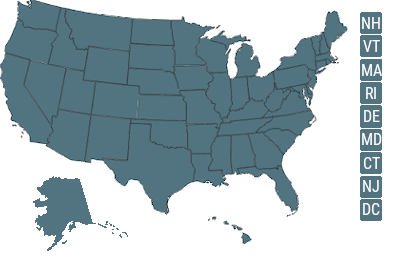
Find nursing licensure requirements by state for RNs, LPNs, LVNs, and advanced practice nurses.
Frequently Asked Questions
What is the NCLEX-RN?
The NCLEX-RN (National Council Licensure Examination for Registered Nurses) is the national licensing exam required for RN licensure in every U.S. state. It’s a computer-adaptive test administered by Pearson VUE on behalf of the NCSBN. The passing standard is set by the NCSBN and is the same across all states.
Can I work as a nurse before passing the NCLEX-RN?
It depends on your state. Some states issue temporary practice permits that allow graduates to work under RN supervision while waiting for exam results. Others permit a limited period of supervised “graduate nurse” practice. Some states require a full license before any nursing practice is allowed. Check with your state board before accepting a position.
How long does it take to get an RN license?
Processing times vary by state and by how quickly all application components are received. Most states process initial licensure applications within a few weeks of receiving a complete application and passing the NCLEX-RN results. Some states are faster. Check your state board’s website for current processing timeframes, as these can shift based on application volume.
What is the Nurse Licensure Compact?
The Enhanced Nurse Licensure Compact (eNLC) allows an RN to hold one multi-state license and practice in any of the 41 member states without additional licensing. The license is issued by the nurse’s home state. Nurses living in non-compact states are not eligible for compact privileges and must apply for endorsement in each state where they want to work.
What happens if my RN license lapses?
A lapsed license means you can’t practice as an RN until it’s reinstated. Most states offer a reinstatement process that requires paying back fees, completing any outstanding CE requirements, and, in some cases, completing a refresher course if the lapse has been significant. Contact your state board directly to find out the specific requirements and timeline.
Key Takeaways
- Two licensing tracks — First-time candidates apply through licensure by examination. Nurses already licensed in another state apply through endorsement.
- NCLEX-RN is universal — All states require it, the passing standard is consistent nationwide, and the exam is administered by Pearson VUE on behalf of the NCSBN.
- Criminal history isn’t an automatic bar — Boards review cases individually, but undisclosed history can carry more weight than the record itself.
- 41 states are in the eNLC — A multi-state compact license authorizes practice in all member states without additional applications or fees.
- Renewal requirements vary by state — Cycles, CE hours, and fees differ. Confirm current requirements with your board before your renewal date.
Select your state to find approved RN programs, specific licensing requirements, application links, and exam information for your jurisdiction.