How to Become a Certified Nurse Midwife (CNM) 2026

Certified Nurse Midwives are APRNs who manage pregnancy, labor, birth, and gynecologic care across the lifespan. Becoming a CNM requires active RN licensure, an ACME-accredited graduate program (MSN or DNP), and passing the AMCB national certification exam before applying for APRN licensure in your state. CNMs are licensed in all 50 states.
Sponsored School(s)


The CNM credential carries a scope of practice that no other nurse practitioner role does: independent authority to manage labor and birth. That single distinction shapes the entire educational pathway, the certification exam, and the state-by-state licensing rules. If you’re an RN researching advanced practice options in women’s health, this guide covers what you need to know before choosing a program.
On this page:
- What Is a Certified Nurse Midwife?
- CNM vs. Other Midwifery Credentials
- Steps to Become a CNM
- Graduate Program Options
- Scope of Practice and Prescriptive Authority
- Salary and Job Outlook
- Frequently Asked Questions
What Is a Certified Nurse Midwife?
A Certified Nurse Midwife is a registered nurse who has completed a graduate midwifery program, passed the AMCB national board exam, and holds APRN licensure. CNMs provide the full spectrum of maternity care: prenatal visits, labor management, vaginal delivery, postpartum follow-up, and immediate newborn care. They also provide gynecologic and reproductive health services, including contraception, well-woman exams, sexually transmitted infection management, and menopause care.
What distinguishes CNMs from other advanced practice nurses is intrapartum authority. CNMs can independently manage normal labor and vaginal birth in hospitals, birth centers, and home settings, depending on state law. Women’s Health Nurse Practitioners (WHNPs) and Family Nurse Practitioners (FNPs) provide extensive gynecologic and women’s health services, but intrapartum care is outside their scope. Hospitals and birth centers look specifically for the CNM credential when staffing labor and delivery units.
CNMs are also distinct from Certified Professional Midwives (CPMs), who are not nurses. CPMs typically focus on out-of-hospital birth and are not recognized in all states. The CNM credential is the most portable midwifery credential in the U.S. and is the only one that supports hospital privileges and prescriptive authority in every state.
CNM vs. Other Midwifery Credentials
There are several types of midwifery credentials in the U.S. They differ in educational requirements, certifying bodies, and legal recognition.
| Credential | Nursing Required | Certifying Body | State Recognition |
|---|---|---|---|
| Certified Nurse Midwife (CNM) | Yes (RN licensure required) | AMCB | All 50 states |
| Certified Midwife (CM) | No | AMCB | Limited but expanding number of states. Verify the current ACNM Certified Midwife state map. |
| Certified Professional Midwife (CPM) | No | NARM | Most states. Out-of-hospital birth focus. Hospital privileges are rare. |
| Licensed Midwife (LM) | No | State-specific | Varies. Typically, out-of-hospital practice only. |
CNMs and CMs hold the same core competencies and sit for the same AMCB exam. The entry point is different: CNMs are RNs first, CMs are not. Because CM recognition is limited to a small number of states, the CNM credential is the default pathway for anyone planning to practice across state lines or in a hospital setting.
Steps to Become a Certified Nurse-Midwife
The pathway to CNM licensure follows four sequential steps. You can’t sit for the AMCB exam without completing an ACME-accredited graduate program, and you can’t enroll in that program without an active RN license. Each step builds directly on the one before it.
Step 1: Earn RN Licensure
All CNM candidates must hold an active registered nurse license. That means completing a board-approved pre-licensure nursing program (ADN or BSN) and passing the NCLEX-RN. Most CNM programs strongly prefer or require a BSN, so completing an ADN-to-BSN bridge before applying to a graduate midwifery program is worth the timeline. Review the RN licensure requirements for your state before planning your application.
Step 2: Build Relevant Clinical Experience
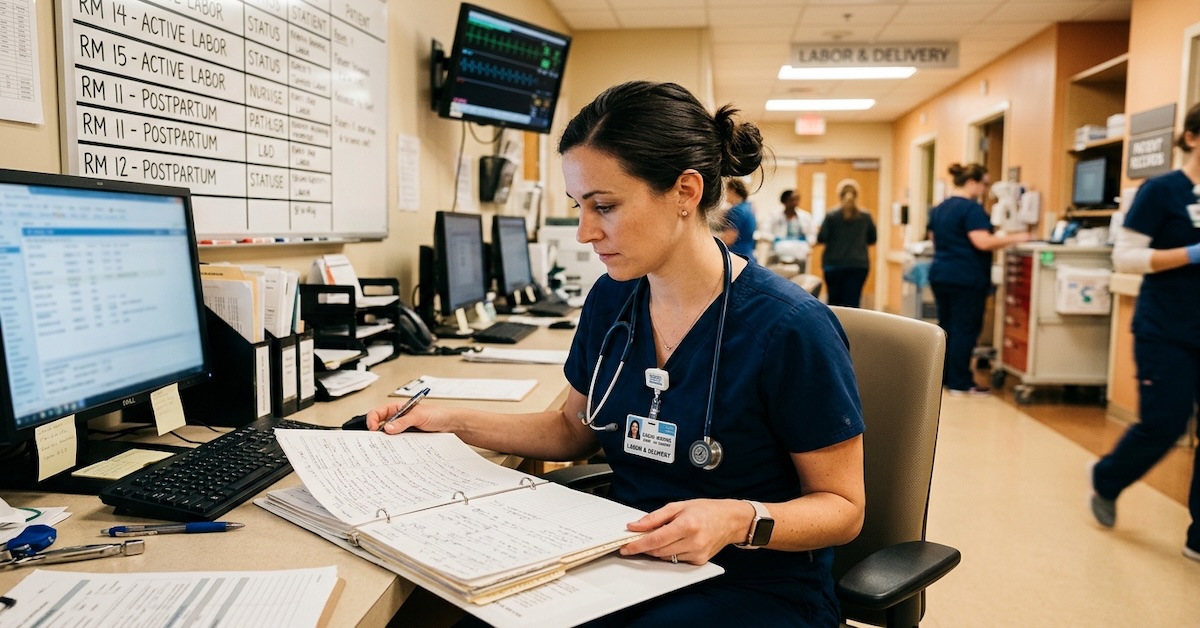
CNM programs don’t universally require prior labor and delivery experience, but most admitted candidates have it. RNs with backgrounds in labor and delivery, antepartum, or postpartum nursing have a measurable advantage in program admissions and in clinical practica once enrolled. Practicing CNMs consistently recommend at least one to two years in an OB setting before applying. If you’re not currently in that role, a position in labor and delivery nursing is one of the most direct ways to build that foundation.
Step 3: Complete an ACME-Accredited Graduate Program
To sit for the AMCB certification exam, you must graduate from a program accredited by the Accreditation Commission for Midwifery Education (ACME). ACME is recognized by the Council for Higher Education Accreditation (CHEA) as the accrediting body for nurse-midwifery and midwifery education programs. The ACME program directory is the definitive reference for currently accredited programs.
Programs offer three degree entry points:
- MSN with a nurse-midwifery specialization
- BSN-to-DNP with a CNM concentration
- Post-graduate certificate in nurse-midwifery (for APRNs who already hold a master’s degree in nursing)
Step 4: Pass the AMCB CNM Certification Exam
The American Midwifery Certification Board (AMCB) administers the national certification exam for CNMs and CMs. After graduation, candidates apply through AMCB and must have the program director verify successful completion directly to AMCB before the application is processed.
The exam is computer-based, delivered through PSI testing centers. Content covers antepartum, intrapartum, postpartum, and newborn care, as well as gynecologic health and professional practice issues. Questions test both clinical knowledge and applied clinical judgment. Candidates have 24 months from program completion to pass and are allowed up to four attempts. AMCB recommends testing as soon as possible after graduation. Pass rates are highest when the content is fresh. After initial certification, CNMs maintain credentials through AMCB’s certificate maintenance program, which runs in five-year cycles and does not require a re-examination.
Step 5: Apply for State APRN Licensure
Passing the AMCB exam earns national certification, but it doesn’t authorize you to practice. You must apply separately to your state board of nursing or the applicable state authority for APRN recognition as a CNM. Requirements vary by state but typically include proof of active RN licensure, AMCB certification, and verification of Completion of an ME-accredited program. Some states also require a collaborative practice agreement with a physician before you can see patients.
CNM Graduate Program Options
Most ACME-accredited programs today use a hybrid model: online or remote didactics paired with locally arranged clinical hours. Fewer programs are fully distance-based, with students responsible for sourcing their own clinical preceptors. Fully on-campus programs exist but are less common than they were a decade ago.
The shift toward DNP as the terminal practice degree has accelerated in recent years. Many programs that previously offered only MSN tracks have added BSN-to-DNP pathways or converted to them. If you’re weighing which degree level to pursue, the MSN degree overview and MSN vs. DNP comparison offer a practical breakdown of the tradeoffs.
Some programs offer dual-role CNM and Women’s Health NP (WHNP) tracks that lead to both certifications on a single clinical pathway. These are worth considering if you want flexibility to practice both intrapartum and broader ambulatory women’s health without completing two separate graduate programs. Ask programs directly whether they offer a dual-role track and confirm current enrollment status during your research.
Before committing to any program, ask directly about average student birth attendance numbers, how the program supports clinical placement in your area, and what their AMCB first-attempt pass rate is. These are the questions that distinguish programs with strong clinical infrastructure from those without.
Scope of Practice and Prescriptive Authority
The CNM’s scope of practice is defined at the state level. The American College of Nurse-Midwives (ACNM) maintains a State Practice Environment map that categorizes each state by practice model. The three primary models are full practice authority, collaborative practice (requiring a physician agreement for some or all services), and supervisory or restricted models.
Prescriptive authority follows a similar pattern. In full-practice states, CNMs can prescribe legend drugs and controlled substances after obtaining APRN licensure, a state prescriptive registration, and a federal DEA number. In collaborative states, prescriptive scope may be tied to the terms of a physician agreement and can restrict which drug schedules the CNM can prescribe independently. California operates under a distinct furnishing model: CNMs obtain a state furnishing number and must complete additional pharmacology training for Schedule II controlled substances.
Some states have recently passed APRN modernization legislation that expanded independent prescribing rights for CNMs, alongside those of nurse practitioners. Confirm the current implementation status directly with your state board of nursing before relying on any specific state statute.
CNM Salary and Job Outlook
According to the Bureau of Labor Statistics, nurse midwives earned a median annual salary of $134,040 as of May 2025. That’s comparable to nurse practitioners, whose median is $132,300, but well below certified registered nurse anesthetists (CRNAs), whose median reaches $236,590. State variation is significant. California reports the highest median in the current BLS state data, at $203,840 as of May 2025, with approximately 870 CNMs employed.
| APRN Role | Median Annual Wage | National Employment |
|---|---|---|
| Nurse Midwife (CNM) | $134,040 | 7,920 |
| Nurse Practitioner (NP) | $132,300 | 323,040 |
| Nurse Anesthetist (CRNA) | $236,590 | 51,840 |
Projections Central forecasts 6.1% employment growth for nurse midwives between 2022 and 2032, with an average of 400 job openings per year. The workforce is relatively small and stable compared with nurse practitioners, for whom projected growth exceeds 44%. Demand for CNMs is consistent in maternity care access settings, particularly in rural and underserved communities where CNMs often serve as the primary obstetric providers.
Sponsored School(s)
Frequently Asked Questions
Do I need labor and delivery experience before applying to CNM programs?
Most programs don’t require prior OB nursing experience as a hard admissions requirement, but competitive applicants typically have one to two years of it. RNs with L&D, antepartum, or postpartum backgrounds move through clinical training more efficiently and perform better in intrapartum practica. Practicing CNMs consistently recommend building that experience before applying, even when programs accept direct-entry applicants.
Can a CNM practice independently?
It depends on your state. States with full practice authority allow CNMs to evaluate, diagnose, prescribe, and manage patients without a physician’s agreement. States with collaborative or supervisory models require physician oversight for at least part of the CNM practice. The ACNM publishes a regularly updated state practice environment map that shows the current status of every state.
How long does it take to become a CNM?
The full pathway typically runs six to nine years from the start of nursing education. A BSN takes four years. CNM programs at the MSN level run two to three years. DNP programs run three to four. RNs who already hold a BSN and apply directly to a graduate midwifery program can typically complete certification in two to three additional years.
What does the AMCB CNM exam cover?
The AMCB exam is a computer-based test administered through PSI testing centers. Content domains include antepartum care, intrapartum management, postpartum and newborn care, gynecologic and reproductive health, and professional practice issues. Questions test both clinical knowledge and applied judgment. The AMCB Candidate Handbook, available on the AMCB website, outlines the full content blueprint and testing policies.
What is the difference between a CNM and a midwife?
“Midwife” is a general term covering several distinct credentials. A CNM is a registered nurse with a graduate degree and AMCB certification, recognized in all 50 states. A Certified Professional Midwife (CPM) is not a nurse and typically focuses on out-of-hospital birth. A Certified Midwife (CM) shares the CNM scope and the AMCB exam, but doesn’t hold an RN license and is recognized in only a handful of states. The CNM credential is the most widely portable and most broadly recognized of these options.
Key Takeaways
- CNM is a distinct APRN credential — the only advanced practice nursing role that includes authority to manage labor and vaginal birth independently.
- ACME accreditation is the gatekeeper — graduating from an ACME-accredited MSN, DNP, or post-graduate certificate program is required to sit for the AMCB certification exam.
- Certification and licensure are two separate steps — passing the AMCB exam earns national certification, but APRN licensure must be applied for separately through your state board of nursing.
- The scope of practice depends entirely on state law — full independent practice is available in many states, but collaborative or supervisory requirements still apply in others. The ACNM state map is the right starting point.
- CNMs earn a median of $134,040 annually — consistent with nurse practitioner earnings, with stronger compensation in high-cost states and persistent demand in rural and underserved maternity care settings.
Find ACME-accredited CNM programs by state, compare MSN and DNP formats, and review application requirements through the program directory below.
2025 US Bureau of Labor Statistics salary data and Projections Central 2022-2032 job growth forecasts for Licensed Practical & Vocational Nurses, Registered Nurses, and Advanced Practice Nurses across roles, reflect state and national data, not school-specific information. Conditions in your area may vary. Data accessed June 2026.