How to Become an Oncology Nurse 2026

Oncology nurses care for patients across the cancer continuum, from diagnosis through survivorship. Becoming one starts with RN licensure through a board-approved ADN or BSN program and the NCLEX-RN. After accumulating 2,000 hours of adult oncology practice, RNs can pursue the OCN credential through the Oncology Nursing Certification Corporation.
Sponsored School(s)


Oncology is one of the largest nursing specialties, with RNs practicing across inpatient acute care, outpatient infusion, radiation oncology, and bone marrow transplant units. The career-defining credential at the RN level is the OCN, administered by the Oncology Nursing Certification Corporation (ONCC). For nurse practitioners who transition to adult oncology practice, the parallel credential is the Advanced Oncology Certified Nurse Practitioner (AOCNP), also offered by ONCC.
On this page:
- What Oncology Nurses Do
- Education and Licensure: Getting Your RN
- OCN Certification for RNs
- Advanced Practice: The Oncology NP and AOCNP Credential
- Oncology Nursing Salary and Job Outlook
- Frequently Asked Questions
What Oncology Nurses Do
Oncology nurses work with patients who have or are suspected of having cancer. The scope spans the full care continuum: screening and early detection, active treatment, symptom and toxicity management, survivorship care, and palliative and end-of-life support. That range is broader than most clinical specialties, and it shapes what both the OCN and AOCNP credentials test.
Clinical Settings and Patient Populations
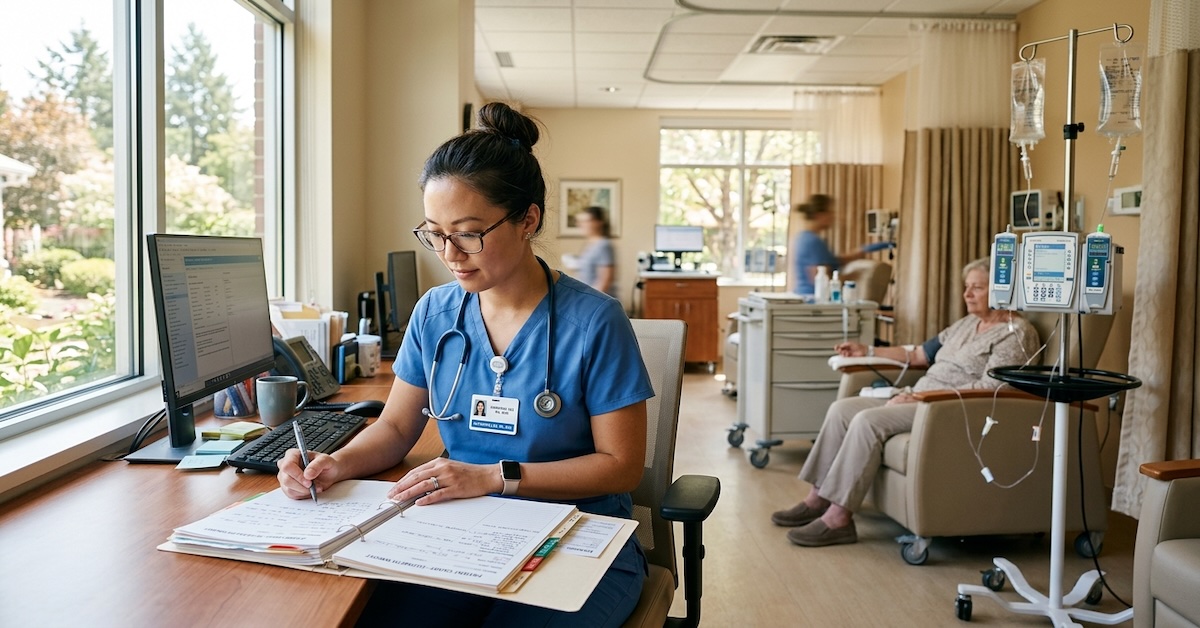
Most oncology RNs work in hospitals or cancer centers, but the setting varies by role. Inpatient oncology units and hematology-oncology floors focus on acute care: managing post-treatment complications, monitoring patients on high-risk protocols, and responding to oncologic emergencies. Outpatient infusion centers administer chemotherapy and biologic therapies to patients who don’t require hospitalization. Bone marrow transplant units and radiation oncology departments have their own specialized populations and protocols. Survivorship clinics and palliative care teams extend oncology nursing into longer-term care management.
Patient populations in both the OCN and AOCNP frameworks are adult. Pediatric oncology is a distinct subspecialty with its own certification pathway through ONCC.
Scope of Practice: RN vs. Oncology NP Roles
Oncology RNs assess patients, administer treatments including chemotherapy and biologic therapies, manage symptoms and treatment toxicities, and provide patient and family education. They carry out care plans and flag changes in patient status to the treatment team.
Oncology nurse practitioners work with more autonomy. They conduct independent assessments, order diagnostic tests, write and modify treatment plans, manage complex symptom presentations across their caseloads, and often serve as the primary point of contact between physician visits. In many oncology practices, NPs manage follow-up care for patients on maintenance therapy or in survivorship.
Education and Licensure: Getting Your RN
The starting point for any oncology nursing career is an RN license. To get one, candidates must complete a board-approved nursing program and pass the NCLEX-RN, a national licensing exam administered by the National Council of State Boards of Nursing (NCSBN). State boards of nursing set the eligibility requirements for sitting for the exam.
ADN vs. BSN Pathways
Both an Associate Degree in Nursing (ADN) and a Bachelor of Science in Nursing (BSN) meet the educational requirements for RN licensure and for eventual OCN eligibility. ADN programs typically run two years and are offered at community colleges. BSN programs run for four years at colleges and universities.
For students who know they want to specialize in oncology, a BSN often makes more practical sense. BSN programs include more clinical hours overall, more room for electives in complex care settings, and better positioning for eventual graduate study. Many oncology employers and clinical ladder programs prefer or require the BSN, and it’s the expected entry credential for nurses planning to pursue an MSN or DNP toward the AOCNP path. For a full comparison of program length, cost, and employer preferences, see our guide to the difference between an ADN and a BSN.
BSN Programs with Oncology Clinical Focus
Not all BSN programs offer dedicated oncology clinical rotations. Students can increase their oncology exposure during pre-licensure education by requesting placements on oncology or hematology units, seeking student positions on oncology floors, and looking for programs affiliated with NCI-designated cancer centers or major academic medical centers with active oncology departments. When evaluating programs, ask about the range of clinical placement sites and whether oncology-focused electives or immersion experiences are available.
OCN Certification for RNs
The Oncology Certified Nurse (OCN) credential is the standard certification for RNs in adult oncology practice. It’s administered by ONCC, an affiliate of the Oncology Nursing Society (ONS), and validates knowledge across the cancer care continuum. You can’t sit for it as a new grad, but once you’ve banked the required oncology hours, it becomes the standard way to signal expertise to employers.
OCN Eligibility Requirements
To qualify for the OCN, candidates must meet all of the following at the time of application and at the time of testing:
- Current, active, unencumbered RN license in the U.S., its territories, or Canada
- At least 24 months of RN experience within the last four years
- At least 2,000 hours of adult oncology nursing practice within the last four years
- At least 10 contact hours of oncology-specific continuing education, or an academic oncology nursing elective, within the last three years
Oncology practice hours can be earned in clinical care, administration, education, research, or consultation, provided the focus is adult oncology. For most RNs, meeting the 2,000-hour threshold alongside the 24-month experience requirement puts the earliest realistic application window at two to three years into oncology practice. Always verify current eligibility requirements directly at oncc.org before applying, as ONCC updates its criteria periodically.
The OCN Exam: Structure and Content
The OCN exam consists of 165 multiple-choice questions completed in three hours. Candidates should consult ONCC for the current scores and pretest item distribution, as those counts are subject to change between exam cycles. The exam follows the ONCC test content outline, published on their website, which serves as the authoritative blueprint for preparation.
Content domains cover cancer continuum care, treatment modalities (chemotherapy, radiation, surgery, biologic and targeted therapies), symptom management, palliative and end-of-life care, survivorship, psychosocial support, and professional practice issues. Nurses who have taken the exam consistently note that symptom management and chemotherapy toxicity are heavily tested, and that time management is a real challenge even for well-prepared candidates.
Renewal and Recertification
OCN certification operates on a four-year renewal cycle. Nurses recertify by building a professional development portfolio of oncology practice hours, continuing education, academic coursework, presentations, and publications, or by retaking the OCN exam. RN licensure must remain current and unencumbered throughout the certification period.
Advanced Practice: The Oncology NP and AOCNP Credential
Nurse practitioners who specialize in adult oncology can pursue the Advanced Oncology Certified Nurse Practitioner (AOCNP) credential through ONCC. AOCNP is the NP-level extension of the OCN framework. It requires graduate NP education, post-graduate adult oncology NP practice, and oncology-specific coursework or continuing education before you’re eligible to sit for the exam.
NP Education Requirements
To become an oncology NP, nurses complete RN to NP programs at the MSN, DNP, or post-master’s NP certificate level in a relevant specialty: Family Nurse Practitioner (FNP), Adult-Gerontology Primary Care NP (AGPCNP), Adult-Gerontology Acute Care NP (AGACNP), or a dedicated oncology NP track. After completing the program, graduates obtain NP certification through a national certifying body (the American Association of Nurse Practitioners (AANP) or the American Nurses Credentialing Center (ANCC)) and then state NP licensure before practicing.
Programs with oncology subspecialty tracks or post-master’s oncology NP certificates build oncology didactic coursework and concentrated clinical rotations into the curriculum. This matters for AOCNP eligibility: graduates of an oncology-concentration NP program need fewer post-graduate practice hours to qualify than graduates of a general FNP or AGNP program.
AOCNP Eligibility: Two Pathways
ONCC outlines two eligibility pathways for the AOCNP. Both require an active, unencumbered RN license and a graduate degree from an accredited NP program. The key variable is the number of supervised adult oncology NP practice hours required, depending on the program’s oncology focus.
| Pathway | NP Program Type | Required Oncology NP Hours | Oncology Coursework or CE |
|---|---|---|---|
| Pathway 1 | Graduate NP program with oncology concentration | 500 supervised adult oncology NP hours within 5 years | One graduate oncology course (2+ credits) OR 30 oncology CE hours within 5 years |
| Pathway 2 | Adult (primary or acute), family, gerontology, or women’s health NP program | 1,000 supervised adult oncology NP hours within 5 years | One graduate oncology course (2+ credits) OR 30 oncology CE hours within 5 years |
Verify current AOCNP eligibility requirements at oncc.org before applying. ONCC updates its certification manual periodically, and specific hour requirements may change between cycles.
The AOCNP Exam
The AOCNP exam uses the same format as the OCN: 165 multiple-choice questions (125 scored, 40 unscored) over three hours. Content domains emphasize assessment and diagnosis, treatment planning, symptom and toxicity management, palliative and end-of-life care, and professional and ethical issues in advanced oncology practice. ONCC publishes the AOCNP test content outline on its website, which serves as the preparation blueprint. Check oncc.org directly for current passing score requirements.
Oncology Nursing Salary and Job Outlook
BLS doesn’t publish separate salary data for oncology nursing as a subspecialty. The figures below show the national median wages for all registered nurses and nurse practitioners as of May 2025. OCN and AOCNP certifications can support clinical ladder advancement and higher pay bands at many employers, but institution-specific oncology differentials aren’t captured in BLS data.
| Occupation | Median Annual Wage | Employment |
|---|---|---|
| Registered Nurses (RN) | $97,550 | 3,379,720 |
| Nurse Practitioners (NP) | $132,300 | 323,040 |
Registered nurse employment is projected to grow 5.6% nationally between 2022 and 2032, with an average of 193,100 openings per year, according to Projections Central. Nurse practitioner employment is projected to grow 44.5% over the same period, with an average of 26,300 openings per year.
Sponsored School(s)
Frequently Asked Questions
Do I need OCN certification to work as an oncology nurse?
No. RNs can work in oncology settings without the OCN. Many employers prefer it or require it for senior positions, charge nurse roles, and specialized units like infusion or bone marrow transplant. It’s also commonly tied to clinical ladder progression and pay band advancement at hospitals with formal career ladder programs.
How long does it take to become eligible for the OCN?
Most RNs reach OCN eligibility two to three years into oncology practice. ONCC requires at least 24 months of RN experience and 2,000 hours of adult oncology practice, both within the last four years. How quickly you hit those thresholds depends on your unit, your assignment, and whether your hours are in direct clinical care or split across other qualifying roles like education or research.
Do I need a dedicated oncology NP program to pursue the AOCNP?
No, but it changes your eligibility requirements. NPs who graduated from a program with an oncology concentration need 500 hours of post-graduate adult oncology NP practice to qualify. Those from a general FNP or AGNP program need 1,000. Both pathways also require oncology graduate coursework or continuing education. If you’re already in an NP program and considering oncology, ask whether your school offers an oncology subspecialty track or a post-master’s oncology certificate.
What study resources do oncology nurses use for the OCN exam?
Most candidates prepare against the ONCC test content outline, available at oncc.org. ONS and ONCC both offer review courses and study bundles. Many nurses also work through OCN review books and question banks with emphasis on symptom management, chemotherapy toxicity, oncologic emergencies, and oncology pharmacology. The exam has a reputation for being more time-pressured than expected, so building timed practice into your prep is worth doing well in advance of exam day.
Key Takeaways
- OCN is the standard RN-level credential — administered by ONCC — that requires 2,000 adult oncology practice hours and 24 months of RN experience within a defined eligibility window.
- AOCNP extends the pathway for nurse practitioners — oncology NPs pursue the AOCNP through ONCC, with practice hour requirements that depend on whether their NP program had an oncology concentration.
- BSN programs offer a stronger oncology foundation — for students who know they want to specialize, a BSN provides more clinical depth and better positioning for graduate study and eventual NP credentials.
- Both credentials renew every four years — through professional development portfolio or exam retake, with RN licensure required throughout.
- NP demand is growing fast — Projections Central projects 44.5% growth in NP employment from 2022 to 2032, with RN employment growing 5.6% over the same period.
Find accredited BSN programs with oncology clinical placement opportunities or MSN and DNP programs with oncology NP tracks using the program search tool below.
2025 US Bureau of Labor Statistics salary data and Projections Central 2022-2032 job growth forecasts for Licensed Practical & Vocational Nurses, Registered Nurses, and Advanced Practice Nurses across roles, reflect state and national data, not school-specific information. Conditions in your area may vary. Data accessed June 2026.